Author: Christopher Woodward

  • When Words Don’t Mean Anything: Analyzing WSB’s Response to the $12.5Billion Treasury Buyback

    When Words Don’t Mean Anything: Analyzing WSB’s Response to the $12.5Billion Treasury Buyback

    Insight: Reddit’s reaction to the $12.5billion Treasury buyback reveals a high-noise, low-signal discourse dominated by filler language rather than economic understanding.

    I saw a r/WallStreetBets post about the treasury buyback, and decided it could be valuable to analyze the language used in the comments to see if any meaningful insight could be extracted; what I found was a clear lack of understanding of the economic event being discussed.
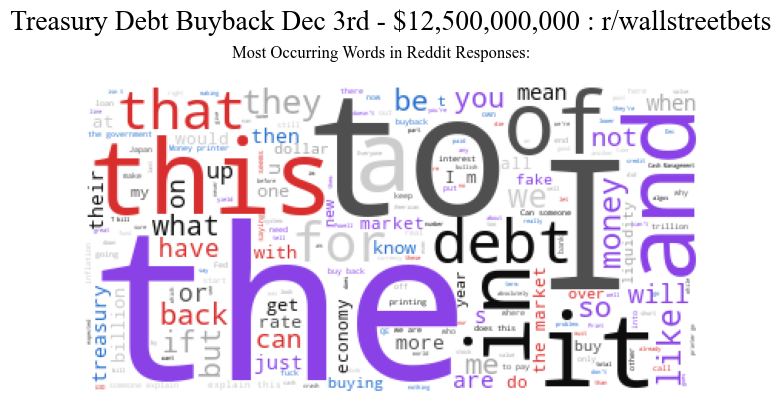

    * Based on analyzing 150 top-level comments, prior to any linguistic cleaning.

    The most dominant words used were filler and function words. Words such as “the”, “this”, “to”, “that”, “of”, and similar. These words typically appear when people are not describing facts, explaining concepts, or articulating structured thought. Instead, they show up when people react emotionally, speak in fragments, or lack the vocabulary and conceptual grounding needed to discuss the topic coherently.

    Once I removed the noise, only basic economic terms remained:“treasury”, “economy”, “money”, “debt”, and the like. This terminology points to people generally not reading past headlines, or genuinely engaging with the substance of the conversation.
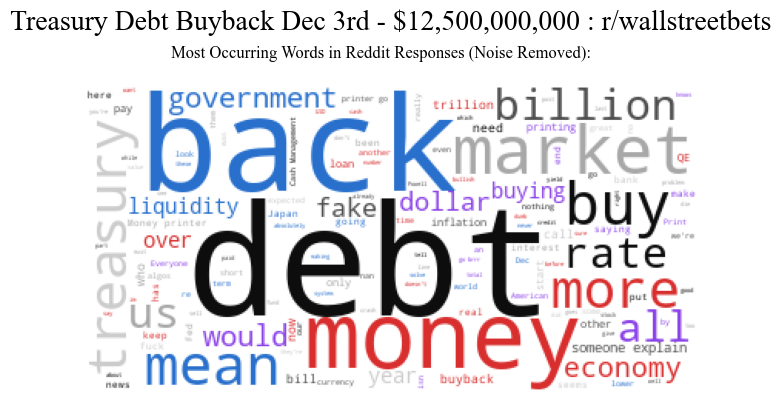

    * Word frequency after removing high-frequency function words to expose topic-relevant vocabulary.

    The insight I gathered from this wasn’t exactly what I expected, but it is valuable nonetheless. Based on the linguistic patterns alone, r/WallStreetBets is not a reliable place to learn anything about economics. The discourse is high in volume but low in informational content revealing more about crowd psychology than about the financial event.


    What looks like market commentary is actually crowd psychology: reactive, emotionally loaded, and informationally shallow.

  • Navarre & Navarre Beach, FL Real Estate Liquidity Analysis

    Navarre & Navarre Beach, FL Real Estate Liquidity Analysis


    Navarre, FL

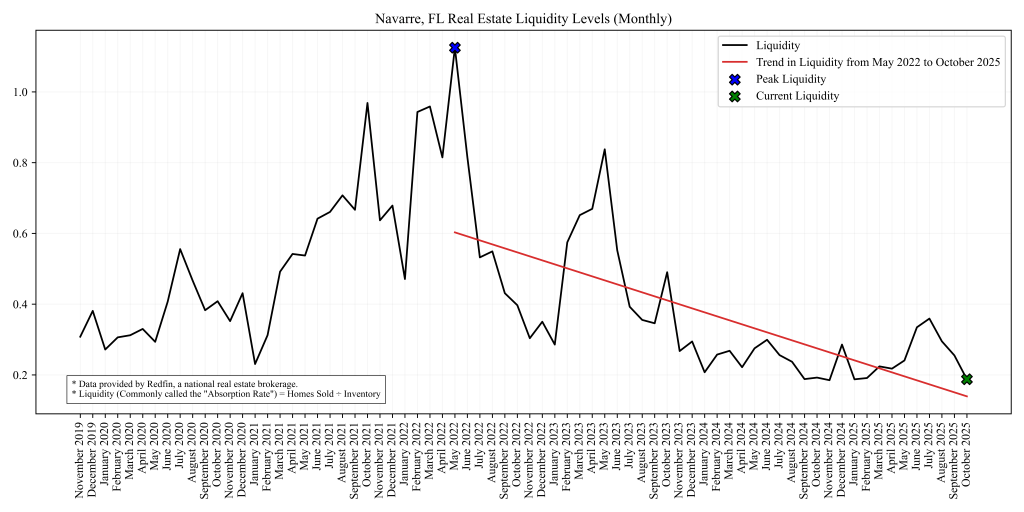
    Liquidity1 fell ~26.41% from September 2025 to October 2025. A drop of this magnitude in a single month suggests fewer buyers acting on available listings despite inventory conditions remaining relatively stable.

    The peak of Navarre’s liquidity occurred in May 2022, when homes were selling at a rate of 1.125 times the standing inventory2. Since this peak, liquidity has fallen 83.31%, reflecting a dramatic long-term slowdown in buyer demand in the area relative to available homes.

    Liquidity of real estate in Navarre, Florida tracked from November 2019 to October 2025. Marked are the peak of liquidity (when homes were selling at the fastest rate) and the level of liquidity in October 2025. A dramatic drop is shown via trend line.


    Navarre Beach, FL

    The Navarre Beach area has seen similar declines. Liquidity in Navarre Beach fell 29.35% from September 2025 to October 2025 indicating the same lack of buyer activity.

    The peak of Navarre Beach’s liquidity occurred in April 2022, just one month behind Navarre, when homes were selling at a rate of 0.7419 times the standing inventory. Since April 2022, liquidity has dropped 91.42% as of October 2025.

    Liquidity of real estate in Navarre Beach Florida tracked from November 2019 to October 2025. marked are the peak of liquidity (when homes were selling at the fastest rate) and the level of liquidity in October 2025. A dramatic drop is shown via trend line.

    Data Source: Redfin, a national real estate brokerage.


    Footnotes

    1. “Liquidity” (also commonly called Absorption Rate) is defined as Homes Sold ÷ Inventory. ↩︎
    2. This happens when homes are selling off the market, which is usually the result of high demand. ↩︎